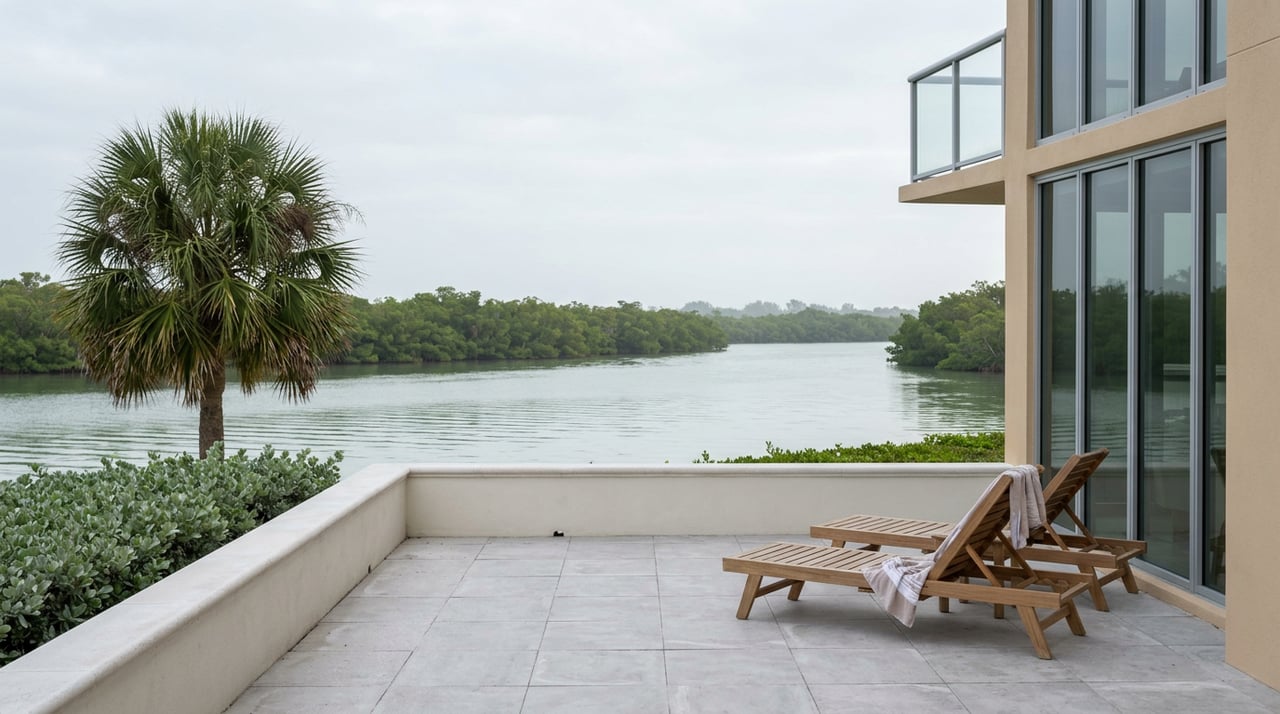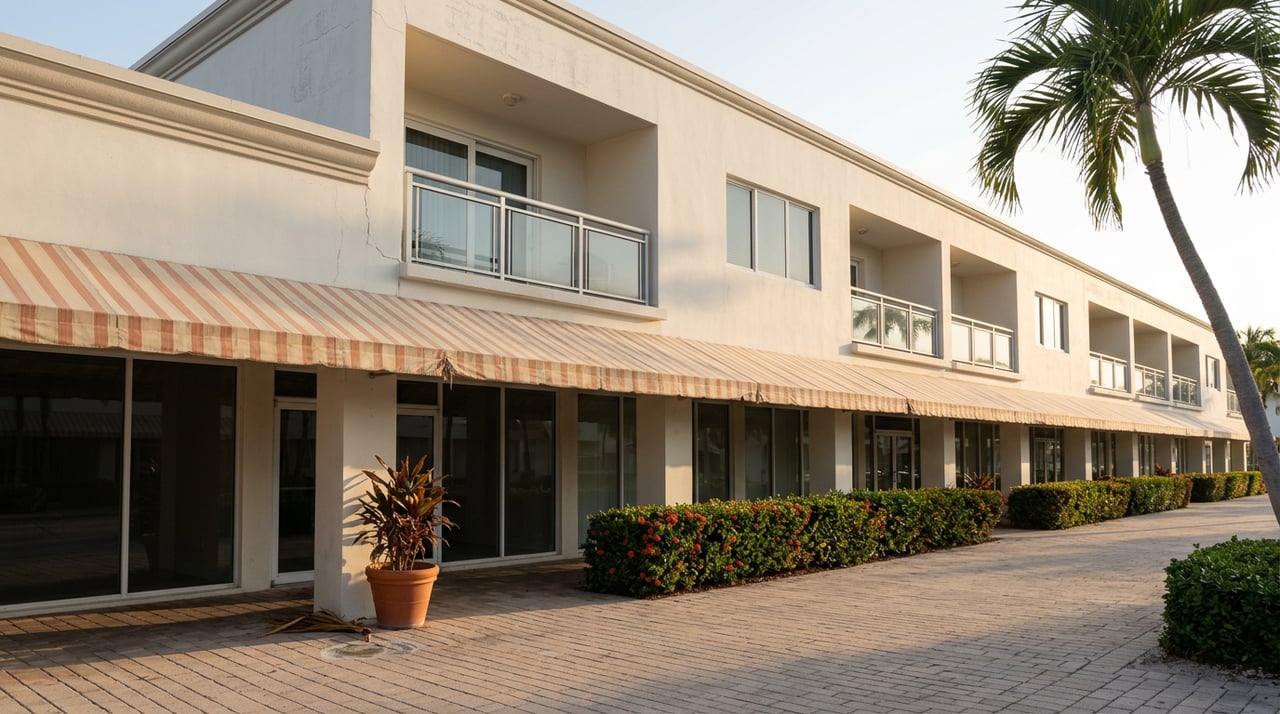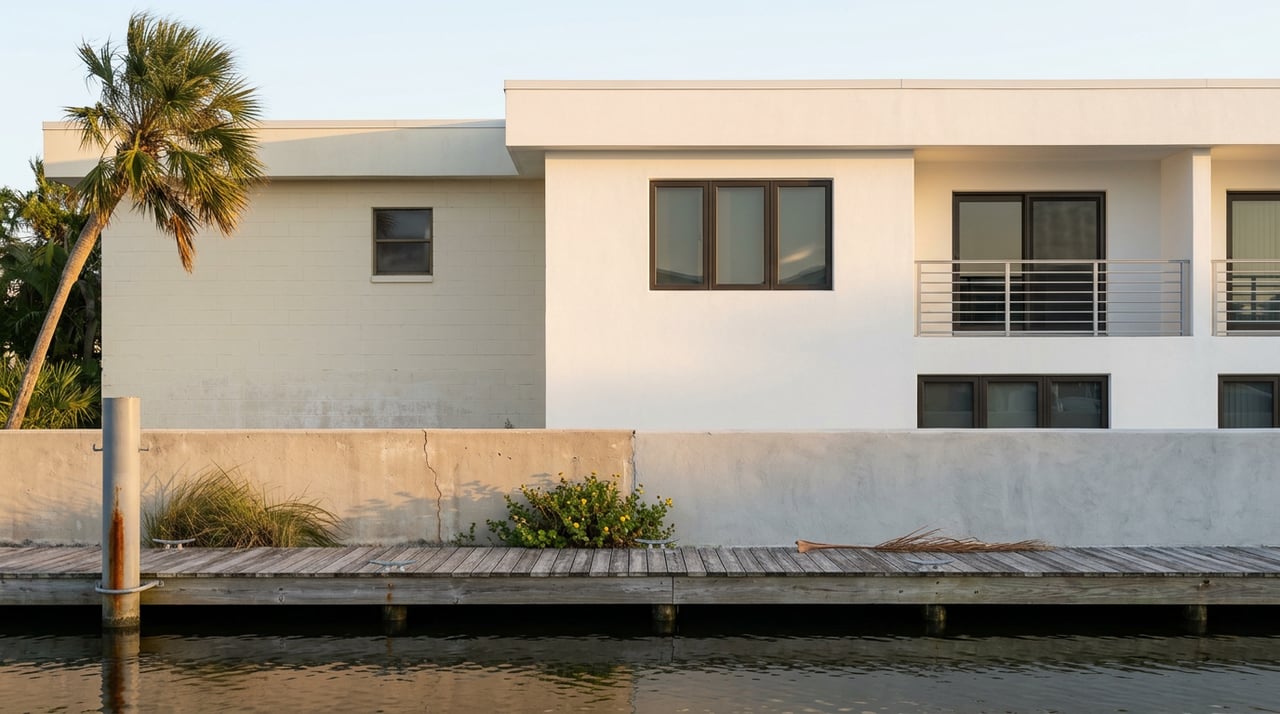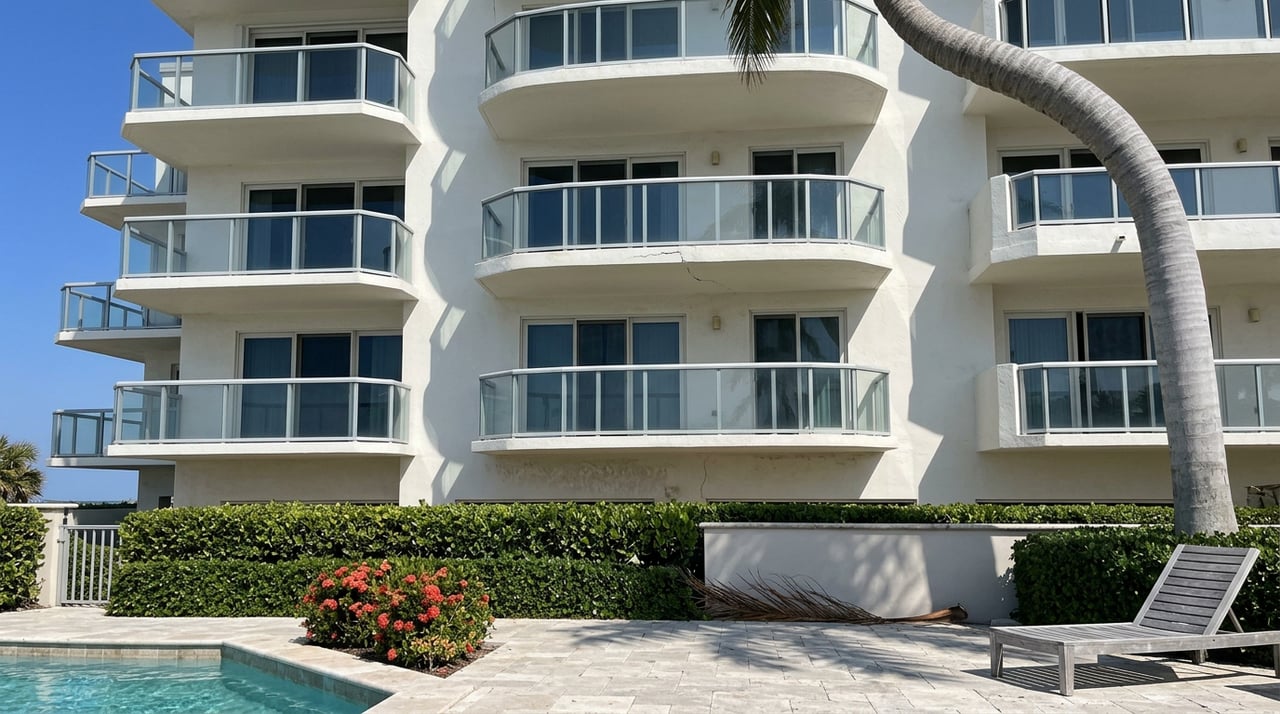
A large sign now stands at the edge of a vacant assemblage on Lake Drive, right where the Blue Heron Boulevard Bridge lands on Singer Island. It shows a rendering of a 25-story tower with a red circle and slash painted over it. Behind that sign, six of the seven parcels needed for the project already belong to a New York-based developer. The seventh is expected to close soon.
That contrast, a protest sign facing land the opposition doesn't own, is the clearest way to understand what's actually happening at the foot of the bridge this summer. Most of the coverage treats this as a standard height fight: neighbors versus developer, reef versus revenue. The more useful question for anyone weighing a Singer Island purchase right now isn't whether this tower gets built. It's which version does, and what that choice quietly tells you about every other parcel like it on the island.
The parcel at the foot of the bridge
The Continuum Company, working with Miami-based architecture firm Arquitectonica, has proposed Singer Island Gateway across five addresses on Lake Drive, an assemblage of roughly three acres just east of the bridge. The plan has moved since it was first reported: Stet News broke the story in March as a 28-story, 298-unit tower, and the version now working through Riviera Beach's approval process is described as 25 stories, close to 350 feet, or nearer to 29 stories once mechanical floors are counted. Plans call for one to four-bedroom residences, a restaurant, retail space, a pool, a padel court, a pickleball court, and a marina meant to give the public continued access to the dive site under the bridge.
That dive site is Phil Foster Park, and it's the reason this particular parcel draws more scrutiny than a typical Riviera Beach proposal. The shallow water around the bridge pilings is an internationally known snorkeling and diving destination, and more than 15,000 people have signed a petition asking the city to protect it, according to CBS12's reporting on the campaign. The city has agreed to commission its own environmental study, paid for by Continuum, and that review hasn't concluded.
The binary residents think they're voting on isn't the real one
At a community meeting in June, held at St. James Missionary Baptist Church on the mainland, hundreds of Singer Island residents pressed the developer on traffic, stormwater, and the shadow a 300-foot tower would cast over the water. Continuum's senior acquisition officer, William Wallace IV, used the meeting to announce something else: the company would build 25 workforce housing units on separate church-owned land in the city, and donate the rent from that project, after expenses, to a consortium of Riviera Beach churches and nonprofits. He put the value at $300,000 to $400,000 a year, or over a million dollars within three years, according to reporting on the meeting.
That workforce housing component isn't a goodwill gesture layered on top of the deal. It's the mechanism that unlocks the extra height. Under the city's baseline zoning for the site, the tower would be capped closer to 22 stories. The workforce housing swap is what gets it to 25.
Here's the part that changes how the opposition should read its own leverage. At the same meeting, the property owner's representative, Alvaro Kraizel, was direct about what happens if this negotiated version collapses. He dismissed the idea that pushback would produce something smaller, calling an eight or ten-story alternative uneconomical on this site, and said that if the current proposal doesn't move forward, the next path is Florida's Live Local Act, the state law that allows more density and height than local zoning would otherwise permit on qualifying workforce housing projects. In his words, Live Local would become "the most viable contender going forward."
So the real choice being negotiated at Singer Island Gateway isn't tower versus no tower. It's a city-brokered deal, with a civic plaza, a marina, church funding, and local hearings, against a state-preempted path that could plausibly be taller, faster to approve, and largely outside the city's control. The petition, the church meeting, and the City Council hearings are all real leverage, but they're leverage inside a negotiation the property owner has already said he'll walk away from if it gets too restrictive.
| Current city-negotiated proposal | Live Local Act alternative (if talks collapse) | |
|---|---|---|
| Height | 25 stories, reached through a local workforce-housing density bonus (up from a 22-story baseline) | Potentially more, since the statute allows greater density and height than local zoning otherwise permits |
| Path to approval | Planning and Zoning Board, CRA, and City Council review | A path the property owner's own representative called the fallback if this deal collapses |
| Community benefits negotiated | $14 million civic plaza, marina, church funding pledge | Not part of this specific negotiation |
| Who's at the table | City boards and residents, through public hearings | Primarily the developer and the state framework |
That table isn't a prediction of what will get built. It's the actual shape of the decision the city, and by extension anyone buying near it, is making.
What the price gap is actually pricing in
Singer Island's numbers have been strong all year. Home prices in the neighborhood were up 15.4% year over year as of March 2026, with a median sale price around $1.1 million and homes taking an average of 128 days to sell, a pace roughly flat compared to the year before. A market analysis of the Riviera Beach submarket covering the second quarter of 2026 put annual condo price growth closer to 7.8%, with inventory tight enough that supply sat around 4.2 months against a longer county-wide average.
The comparison to Palm Beach Island shows up constantly in how brokers describe the shift: waterfront that costs $7 million on Singer Island might run $15 to $20 million a few minutes south. That gap is real, and it's a legitimate reason buyers are looking here instead. But a price gap that wide, on a barrier island with a fixed amount of buildable land, is also a bet. It's a bet that parcels like the one at 2525 Lake Drive get built out to something closer to their maximum allowable density over the next cycle, not that they stay as they are.
Riviera Beach's own 2023 Community Redevelopment Plan already identified the properties fronting Blue Heron Boulevard, on the Singer Island side of the bridge, as a corridor the city wanted to see developed more intensely, reinforcing the road's role as the gateway to the island. That predates Continuum's proposal entirely. The specific tower is contested. The direction of the corridor was decided years ago.
Why this cuts differently depending on where you're looking
If you're comparing a unit in one of the established oceanfront buildings farther out on the island against something closer to Lake Drive or the west side near the bridge, the Gateway fight matters to you in different ways.
For the established oceanfront core, the exposure is mostly indirect: added traffic on the one corridor most residents use to reach the mainland, and years of construction activity nearby if the project proceeds. It doesn't touch sightlines, HOA finances, or building character.
For anything closer to the bridge itself, the exposure is direct. A buyer there isn't just weighing a building's current condition. They're weighing what gets built next door, on what timeline, and under whose design review. That's not a reason to avoid the corridor. Land near a gateway parcel that's likely to urbanize is often where the next round of appreciation shows up first. It's a reason to ask more specific questions before writing an offer: what's the status of the environmental study the city commissioned, when is the next Planning and Zoning Board or City Council hearing scheduled, and has anyone disclosed pending land use cases within view of the property. A listing sheet won't answer those. A conversation with someone tracking the hearings will.
A few questions that come up often
Has Singer Island Gateway been approved? No. As of this writing it remains under review by Riviera Beach's Planning and Zoning Board, Community Redevelopment Agency, and City Council, with the city's own environmental study still outstanding.
If residents block this version, does the parcel just stay vacant? Based on the property owner's own representative's statements at the June meeting, that's not the outcome on the table. The stated fallback is a Live Local Act project, which could arrive with less local input, not more.
Does this affect every Singer Island listing? No. Its relevance scales with proximity to the bridge corridor and to Lake Drive. Buildings well east of the span, closer to the ocean, feel the traffic ripple more than the direct construction impact.
Where this leaves a buyer
None of this changes whether Singer Island is worth pursuing. It changes what "worth pursuing" should account for near this specific corner of the island. Understanding a pending land use case, and the incentive structure behind it, is exactly the kind of local detail that doesn't show up in a listing description but shapes what a property is actually worth in three years.
If you're weighing a purchase near the bridge, or trying to understand how a project like this affects a building you're already watching, Dawn Sacco can walk through the specifics with you. Let's Connect.