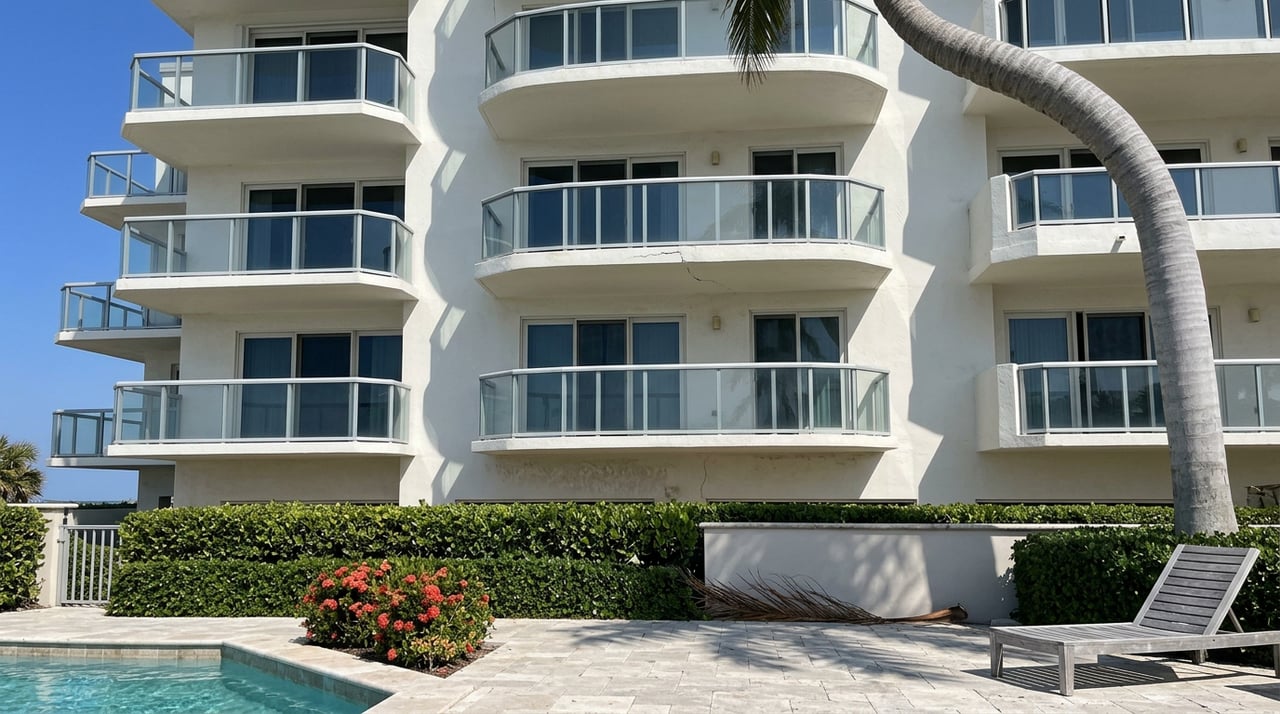
In late 2024, Dunes Towers resident Mona Guynn opened a letter from her association board and found a bill she hadn't budgeted for. Concrete work. Plumbing work. A number in the neighborhood of $70,000.
"It was $70,000 for concrete work, plumbing work, all that and it's still going on," Guynn told CBS12 at the time. She wasn't the only one doing that math. The same report featured Will Perryman, a retiree who owns two condos on Singer Island, and Andrea Trevino, another resident, both airing the same worry about assessments they hadn't planned for. Trevino said not knowing the final number, or whether she would have the savings to cover it, was the hardest part.
The easy read of that story is the one most condo guides have been repeating since 2022: old building, old problems, buyer beware. Dunes Towers went up in the 1970s, and Florida's post-Surfside inspection laws came for buildings of that vintage first. But that reading gets the mechanism backwards. By the time that letter arrived, Dunes Towers had already carried out a two-year, building-wide restoration covering concrete, roofs, and fire sprinklers, work that ran from 2021 to 2023 and was financed through an SBA loan that residents are still paying down in their monthly fees. The building wasn't hiding a problem. It had already found one, fixed it, and was working through the bill.
The question that actually predicts what happens to your dues on Singer Island in the next few years isn't how old the building is. It's where that building sits on Florida's compliance calendar, and whether the bill for its structural health has already landed or is still coming.
Two Clocks, Not One
Florida runs two separate requirements for condo and co-op buildings three stories or taller, and conflating them is where a lot of buyers get tripped up.
The Milestone Inspection, under Florida Statute 553.899, is triggered by age. The standard threshold is 30 years, though local building officials in coastal jurisdictions can require it earlier, and it repeats every 10 years after that. It's a structural inspection, first a visual pass, then a deeper engineering review if that pass raises concerns.
The Structural Integrity Reserve Study, or SIRS, under Florida Statute 718.112(2)(g), is triggered by height, not age. Any residential condo or co-op building three habitable stories or taller needs one, on a 10-year cycle, regardless of how new it is. A tower finished this year still needs a SIRS on file within roughly a decade of its creation. For existing owner-controlled associations, the initial SIRS deadline was December 31, 2025, and that date has already passed as of this writing. Boards can no longer vote to waive funding for the eight structural categories a SIRS covers, and the statutory reserve threshold that triggers mandatory funding rose to $25,675 for 2026.
That second clock is the one most buyers miss. A brand-new building on Singer Island isn't exempt from this conversation. It's just earlier in it.
What This Looks Like, Building by Building
Singer Island's condo stock spans five decades, and each era is sitting at a different point on these two clocks.
| Building | Built | Where It Stands |
|---|---|---|
| Tiara | 1977 | Underwent a full gut renovation in the early 2000s, hurricane-impact glass, new electrical, new plumbing, all already in place well ahead of current law |
| Dunes Towers | 1970s | Carried out a two-year, building-wide concrete, roof, and fire-sprinkler restoration from 2021 to 2023, financed through an SBA loan still being paid down in monthly fees |
| Seawinds | 1984 | A recent listing for a unit there advertises that the building has completed all SIRS requirements and reviews, using compliance itself as a selling point |
| One Singer Island | 2006 | Not yet old enough to trigger a milestone inspection, but its SIRS obligation under the height-based rule already applies |
| 5000 North Ocean | 2019 | Same height-triggered SIRS obligation applies here too. Being a few years old doesn't put the requirement off indefinitely |
Line those up and the pattern isn't age. It's whether the building has already absorbed its structural bill or is still approaching it.
Why the 1977 Tower Can Be the Safer Buy
If you're comparing a unit at Tiara against something at a newer resort-style tower, the instinct is to assume the older building carries more risk. On paper, in terms of what's already been spent and verified, it can be the opposite.
Tiara's renovation happened more than two decades ago, well before any of this was state law, and it already carries impact glass and rebuilt systems that a milestone inspection would be checking for today. Dunes Towers has a documented, completed restoration with a financing plan already in place. Seawinds is now marketing its finished SIRS paperwork the way another building might market a renovated lobby. In each case, the number is known and the work is done.
A newer building's SIRS obligation, on the other hand, is often still ahead of it. That doesn't make the building unsafe. It means the reserve math, and the possibility of a future assessment to fund it, hasn't been fully written yet. Buying there means buying into an unfinished sentence.
None of this has slowed the market. Through mid-May 2026, condo sales across Singer Island and neighboring Palm Beach Shores matched the pace set over the same period in 2025, with dollar volume running slightly ahead of last year and homes at $2 million and above accounting for more than half of that volume, a larger luxury share than either of the two previous years. Buyers aren't avoiding older buildings. They're pricing the compliance stage, not the birth certificate.
What to Put in Writing Before You Offer
For a Singer Island condo at any age, the documents that actually tell you where a building stands are the same:
- The most recent Milestone Inspection report, including whether it flagged substantial structural deterioration
- The current SIRS, with its funding schedule for the eight required structural components
- The last 12 months of board meeting minutes, which often reference pending assessments before they're formally voted
- Confirmation of the building's status on Fannie Mae's condo eligibility list, since inadequate insurance or unresolved repair findings are the two most common reasons a building loses conventional financing
- The master insurance policy and its recent premium history
Associations with 25 or more units are now required to post many of these documents to a website or app, so asking should get you an answer quickly. If it doesn't, that delay is itself useful information.
Two Questions Worth Asking Directly
If a special assessment was already approved before I make an offer, who actually pays it? Contract language controls this, but the common convention in Florida condo purchase contracts is that an assessment levied before the contract's effective date is the seller's responsibility, and one levied after becomes the buyer's. Read the assessment-allocation clause before you sign anything, not after.
Does buying something built in the last few years mean I can skip this conversation? No. The SIRS requirement is tied to a building's height, not its age, so a tower finished this year is on the same 10-year clock as one finished in 1984. It's simply earlier in the cycle.
Singer Island isn't more or less exposed to this than the rest of coastal Florida. What's different is that its building stock spans nearly every era this law was written to address, which makes it a useful place to see the pattern clearly: the number that matters is not the year on the certificate of occupancy. It's whether the structural bill has been paid.
If you're weighing a specific building on Singer Island and want a second set of eyes on its inspection history or reserve documents before you write an offer, Dawn Sacco has spent years learning these buildings from the inside. Let's Connect.